
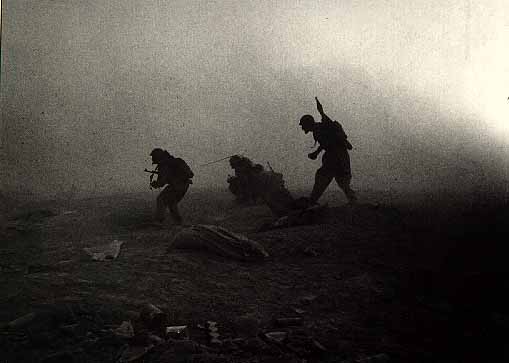
Today, we’re finishing up last Friday’s debate. Chime in below.
Motion for debate: Progress Is Inherently Violent.
Matty P, arguing for the motion, with his rebuttal:
Life is antagonistic. It’s a violent process. Organic metabolic processes based on catabolism and anabolism. Competition and predation. Adapting to the environment and affecting that environment to better suit the organism. Evolution is referred in the simplest terms as survival of the fittest. So too is innovation a simple expression of that evolution, of the violent existence that is life itself.
Eric isn’t wrong. Humanity is becoming less violent. Previous innovations of technology and thought have progressed us past simple reliance on basic impulse. Further, we also agree that our technology is more advanced, creating greater inter-connectivity. However, these assertions do not negate the simple nature of how life progresses.
Take Eric's example of a man belonging to a nation. The sense of belonging is an ideal. There will always be differences between human beings based upon skin color or wealth or location which will cause division. The reality is that groups within these nations that still are antagonistic toward one another despite the existence of peer groups of various sizes. The most apt example: Crips and Bloods are of one nation and still wish each other harm.
But this is tangent to the original assertion that progression is either propelled or follows violence. The following are simple examples:
- Life and growth as an organism (individual progress to maturity) requires catabolism and consumption of sources of energy derived from other living organisms.
- As stated previously, advance in prosthetic limb technology has always followed closely the influx of soldiers wounded by war.
- Space exploration (i.e. the Hubble telescope and moon landing and innovations of scientific theory tied to these feats) originated as an arms race.
- Nuclear energy could not exist without the Manhattan Project.
- Curing disease is nothing more than killing micro-organisms.
- Sterile surgical and medial techniques were pioneered by combat medics during the civil war to prevent infection to wounded soldiers.
- Collecting written knowledge requires cutting down trees.
- Collecting our supply of digital knowledge requires energy and materials produced by natural resources procured by altering the landscape and displacing organisms
Is man capable of progressing without innovation without violence? Sure. I’ll concede that. We can make small advances. But we are not to the point that major innovation is independent of the violent nature of life itself. Maybe someday, but not yet.
Eric C, arguing against the motion, with his rebuttal:
Is humanity violent? Certainly. Humanity was, is and will be violent for thousands of years to come, otherwise you wouldn’t be reading a blog called, On Violence. But the question for debate today is whether progress (or technology) is inherently violent. Put another way, does technology make us more violent? Does it encourage violence?
The answer is no. As I proved last Friday, via Stephen Pinker via long term trends and statistics, society is less violent now because technology continues to improve. Ergo, technology isn’t violent.
Will there still be examples of violence and antagonism? Of course. As I mentioned in my original argument, “The path to perfection will be paved with missteps, errors and violence, but the end result is a net positive.” Modern examples of violence are just anecdotes, not statistics.
Matty P mentions the Crips and Bloods. Los Angeles’ murder rate--314 murders in 2009 in a city of millions--is minuscule compared to almost any other era in the past; the feuding clans in 1800s America make modern day gangs look like Little Leaguers. The most important thing is why: technology. Television news broadcasts, telephone calls to 911, police radios, police cars, and forensics all enable a more secure, modern world.
Has the military, or war, fueled progress and the invention of new technologies? Absolutely. But I’d love to see a comparison between non-military patents and military patents. Most technology (electricity, telephones, lightbulbs, etc) is non-military.
A final thought: Matty P brought up evolution and competition, but I don’t think this picture is as complete as it originally appears.
According to some new theories--courtesy of Radiolab--natural selection didn’t actually apply during the first one billion years of unicellular life. Cell membranes were porous, so unicellular organisms shared everything, depending on what worked. Steve Strogatz, an applied mathematician at Cornell, describes the whole thing as some giant, communistic “a rampant sharing of molecules, it’s an orgy...a commune.” Basically, evolution via natural selection didn’t apply. Cooperation ruled over competition.
Then, one cell stopped sharing. And competition began. Life fought against other life. This went on for 3 billion years. Natural selection.
Then something else happened. Mankind defeated evolution. We’ve gone past it, evolved beyond it. We make our own food. We can kill any animal. And now we can manipulate our own cells, swapping genes at will. Swapping genes means Darwin’s theory no longer applies. We’ve subverted the natural order. Darwin’s laws no longer apply to us. Survival of the Fittest is now survival of humanity, and the survival of the environment through land and species preservation. We’ve moved beyond the animals.
We’re moving towards utopia, eradicating sickness and disease, becoming less violent, preserving the natural world, and ending competition.
How did we do it? Technology. And progress.


